The beatitude "Blessed are the poor in Spirit," St. Augustine takes to refer to those who realize the depths of their sin and their inability to fix it. He writes, "the poor in Spirit are rightly understood here as meaning the humble and God-fearing... Nor ought blessedness to begin at any other point whatever if indeed it is to attain unto the highest wisdom; but fear of the Lord is the beginning of wisdom; for on the other hand also, pride is entitled the beginning of all sin." The humble realize that God alone is Holy and stand in awe and reverential fear of their divine King. They realize that they are nothing and that the world is nothing in comparison to the God who is everything.
It is the gift of fear that inspires the true fruit of poverty of Spirit. It clears out any desire to sin in our lives. It breaks any and all dealings with the devil. This requires a power greater than our own: the Spirit of Love. Through the gifts of the Holy Spirit, we are given a divine instinct to live at a divine mean of virtue. What would be foolishness in the eyes of the world becomes infused with the power of God and thus fruitful. The gift of fear often inspires us to live the evangelical counsel of poverty by causing us to despise the goods of this world (even lawful ones!) and to prefer the goodness of God.
Until we value the love of God above all else, we will always remain a tepid soul, always in danger of Hell and never enjoying the life of the kingdom which is available to us even now. Fear of the Lord and poverty of Spirit sets us free to love with restraint. Fear of the Lord liberates us from our stupid-selfish desires and orientates us to the Other who fulfills all our desires. One cleaves to Him and sells everything else. How could it be any other way? When we possess God, we possess everything we could ever desire. All things are good only in as much as they resemble God in whom there is not even the shadow of undesirable being. He is pure loveliness and beauty. No one could see Him face to face and not cling to Him with their whole undivided will. When, therefore, we exalt the things of this world above God (pleasure, money, power, or honor), we lie about the goodness of God. It is a statement that He is not fully satisfactory.
Do you not believe that God is pure loveliness and beauty? Then look to the life of Jesus from whose heart blood and water poured for the salvation of the world, whose love snapped the chains of death, and whose life radiates in the heart of every saint who confesses Him as Lord, sitting at the right hand of the Father. Jesus is the refulgence of the Father's glory.
Growth in the Spiritual life begins with fear of the King. St. Thomas Aquinas writes, "Since beatitude is an act of perfect virtue, all the beatitudes belong to the perfection of the Spiritual life. And this perfection seems to require that whoever would strive to obtain a perfect share of spiritual goods, needs to begin by despising earthly goods, wherefore fear holds the first place among the gifts." If we cling to the world, we won't cling to God, the sight of whom is our Heavenly inheritance. Like so many chains, our distort desires attach us to the world. These chains crank our head down so that our vision is only of this fallen world. Blessed be God who cuts these chains by the sword of the Spirit! Once liberated, we can turn our heads to see the kingdom of God.
Therefore, its not without reason that St. Thomas treats his discussion about the gift of fear and poverty of Spirit in his treatise on Hope. The theological virtue of Hope does not seek salvation in this world or from this world. It seeks it in the Father who has promised in His Son salvation if only we put our trust in Him and remain in Him. When we approach God devoid of any worldly goods, in poverty of Spirit, our Hope can only be in the Lord.

Friday, November 22, 2013

Sunday, October 27, 2013
Prepared to Make a Defense
An atheist’s favorite weapon is science. They gleefully shout that science disproves religion and belief in God is irrational. But is this true? Some of the world’s greatest scientists were devout Catholics. Gregor Mendel, the founder of modern genetics, was a religious priest, and Georges Lemaître, a Jesuit priest, was the first to theorize the big bang. Neither of these brilliant men thought that science disproved religion. Many atheists have fallen victim to an error called scientism. Scientism is the belief that we only know truth through science. They would say that if it’s not scientific knowledge, it is not knowledge. Operating out of this perspective, they conclude that God does not exist. Science studies changes in material things, but God isn’t material and doesn’t change. He can’t be investigated by science. Therefore, they conclude, God doesn’t exist. However, scientism is a false perspective. If we only know truth through science, how do we know that scientism is true? We certainly couldn’t prove it by doing scientific experiments. What kind of experiment would we conduct?
Instead, our culture needs to rediscover an appreciation for philosophy. Philosophy is not merely one’s opinion about life or the world, but it is the rational investigation of our basic beliefs about reality. It requires logic and critical thinking. It asks questions about what does it mean to know, the existence of the soul, morality, and the existence of God. The Catholic Church is convinced that the human person can reason to the existence of God. Bl. John Paul II wrote an encyclical to this effect entitled Fides et Ratio (Faith and Reason), but it has even more ancient roots in St. Paul who wrote, “Ever since the creation of the world, his invisible attributes of eternal power and divinity have been able to be understood and perceived in what he has made” (Rom 1:20).
In order to understand how we might prove God’s existence, we need to refine our understanding of causation. Suppose you drove towards some train tracks, and to your dismay, there was a single train car blocking the whole road. You would be frustrated because you that the train car is not going to move on its own, it does not have the power to move itself. It requires a train engine. In philosophy we call this a “first cause.” First, here, does not mean first in time but first in priority. Without a first cause which has within itself the power to change, nothing else in a chain of causes can happen. It doesn’t matter if there is one train car or an infinite number of train cars. When there is no train engine, not a single train car can move.
The whole universe is like this in regards to being. Things come to be and then cease to be, yet nothing is the cause of its own being. My existence is not something I chose; it is caused by something outside of me. Even fundamental particles undergo change; otherwise, we couldn’t observe them scientifically. The question then arises, what is the underlying cause of all this change and of existence itself? There must be something which is at their origin. The creator of all change and existence is what Christians and other religious peoples have called God.
If God is the origin of all that happens in the world, the world is not a place of chance and uncontrollable forces, but we can trust that God is at work even in the midst of our suffering. The reason for suffering might not be perceptible to us, yet God is in control. This is the beginning an answer to the problem of evil. God allows evils so that we might gain some other good by them just as a good author allows some evils to befall his or her characters so that they might grow, develop, demonstrate bravery, and other virtues. If we only look at one scene in a story, it might seem cruel and tragic. However, if we look at the entire narrative, something beautiful emerges. This doesn’t mean that God has created evil, because evil doesn’t have its own existence. Evil is more like a hole in a sock and darkness. It is the absence of a good whether it be love, self-control, or justice. Death is the absence of life. Disease is the absence of health. Evils are little holes in the world that God permits creatures like us to make for the sake of the beauty of His story.
The full answer to the problem of evil is found in Jesus the Christ who enters into the human story, shoulders our suffering, and makes the cross the cause of salvation. His death becomes the occasion of life for the human race. As Christians, we don’t need to be afraid of objections from unbelievers. Objections need to become opportunities to deepen our understanding of the faith. Only then will we “always be ready to give an explanation to anyone who asks you for a reason for your hope” (1 Pt 3:15).
Instead, our culture needs to rediscover an appreciation for philosophy. Philosophy is not merely one’s opinion about life or the world, but it is the rational investigation of our basic beliefs about reality. It requires logic and critical thinking. It asks questions about what does it mean to know, the existence of the soul, morality, and the existence of God. The Catholic Church is convinced that the human person can reason to the existence of God. Bl. John Paul II wrote an encyclical to this effect entitled Fides et Ratio (Faith and Reason), but it has even more ancient roots in St. Paul who wrote, “Ever since the creation of the world, his invisible attributes of eternal power and divinity have been able to be understood and perceived in what he has made” (Rom 1:20).
In order to understand how we might prove God’s existence, we need to refine our understanding of causation. Suppose you drove towards some train tracks, and to your dismay, there was a single train car blocking the whole road. You would be frustrated because you that the train car is not going to move on its own, it does not have the power to move itself. It requires a train engine. In philosophy we call this a “first cause.” First, here, does not mean first in time but first in priority. Without a first cause which has within itself the power to change, nothing else in a chain of causes can happen. It doesn’t matter if there is one train car or an infinite number of train cars. When there is no train engine, not a single train car can move.
The whole universe is like this in regards to being. Things come to be and then cease to be, yet nothing is the cause of its own being. My existence is not something I chose; it is caused by something outside of me. Even fundamental particles undergo change; otherwise, we couldn’t observe them scientifically. The question then arises, what is the underlying cause of all this change and of existence itself? There must be something which is at their origin. The creator of all change and existence is what Christians and other religious peoples have called God.
If God is the origin of all that happens in the world, the world is not a place of chance and uncontrollable forces, but we can trust that God is at work even in the midst of our suffering. The reason for suffering might not be perceptible to us, yet God is in control. This is the beginning an answer to the problem of evil. God allows evils so that we might gain some other good by them just as a good author allows some evils to befall his or her characters so that they might grow, develop, demonstrate bravery, and other virtues. If we only look at one scene in a story, it might seem cruel and tragic. However, if we look at the entire narrative, something beautiful emerges. This doesn’t mean that God has created evil, because evil doesn’t have its own existence. Evil is more like a hole in a sock and darkness. It is the absence of a good whether it be love, self-control, or justice. Death is the absence of life. Disease is the absence of health. Evils are little holes in the world that God permits creatures like us to make for the sake of the beauty of His story.
The full answer to the problem of evil is found in Jesus the Christ who enters into the human story, shoulders our suffering, and makes the cross the cause of salvation. His death becomes the occasion of life for the human race. As Christians, we don’t need to be afraid of objections from unbelievers. Objections need to become opportunities to deepen our understanding of the faith. Only then will we “always be ready to give an explanation to anyone who asks you for a reason for your hope” (1 Pt 3:15).
Sunday, October 20, 2013
In the Pursuit of Wisdom
I love to study. Any given week I might read Hans Urs Von Balthasar, St. Augustine of Hippo, St. Thomas Aquinas or Joseph Cardinal Ratzinger. Each theologian diligently studied the Scriptures and the Tradition seeking a divine wisdom, rich in treasure. Because of human weakness, our own perspectives of the world are limited. Only after heroic efforts, do we come to a partial understanding of the truth. However, by faith in Jesus, we have access to the Divine perspective. Jesus offers us a wisdom which surpasses human understanding.
Wisdom is the basis for love. Those who clearly perceive reality both see how good it is and know how to be a steward of that goodness. The people we love most are those whom we know most intimately. Knowledge of our friends brings us joy when we think about them and experience them. It’s when a person shares their inner most concerns that friendships are formed. This self-communication is a self-gift at the most intimate level. By giving knowledge of yourself to another, you entrust yourself into the other’s care, and as the other receives that knowledge, a friend takes you into his or her self. When this exchange happens, we begin to see the value and goodness of the other and wish to build him or her up in love.
Self-communication is the basis of our relationship with God. Jesus is the Word of God; He is the Father’s final and definitive self-communication. Our faith mediates to us a real experience of the love of Jesus, crucified and risen. The Bible and the Sacred Tradition of the Church give us trustworthy testimony to who Jesus is and who God is at the most intimate level—God is love. The complex mysteries of the faith are elaborations on this one central mystery. When we speak of the Trinity, we speak of a God in three persons who are bound in an eternal procession of love. The Father loves the Son and the Son loves the Father, and this love between the Father and the Son is so real that it is the Holy Spirit. When we speak about the Incarnation, we are speaking about the God who so loved the world that He gave His only Begotten Son. Out of love for us, Jesus assumed humanity and all the consequences of sin so that He could exchange our death for His life. When we know these truths about God, we realize who He is and can discern how best to pursue Him. God’s self-revelation becomes a source of wisdom.
The fullest expression of wisdom is knowledge of God. If we know God, we see reality in its fullness because the whole world is a pale reflection of the beauty of God. All creation finds its source, pattern, and purpose in God. If we pursue this wisdom, we see the world as it is and as it is meant to be. God’s wisdom is without failure; He is not bound to the narrowness and errors of human persons. In wisdom we can find joy and delight because knowledge of another person inspires love. The Bible says, “Wisdom exalts her sons and gives help to those who seek her. Whoever loves her loves life, and those who seek her early will be filled with joy. Whoever holds her fast will obtain glory, and the Lord will bless the place she enters” (Sir 4:11-13). No one has more glory or blessings than the one who loves as a result of knowing Love Himself. That person has been made a partaker in the divine nature (2 Pt 1:4).
In this life, the pursuit of wisdom is difficult, but every step forward is worthwhile. It begins with the fear of the Lord (cf Sir 1:13). Those who fear the Lord wish to always remain at His side because they love Him and do not want to separate themselves from Him. We abide in the Lord through the Sacraments, especially the Eucharist (Jn 6:56) and through keeping Jesus’s commandments (Jn 15:10). Pursuing wisdom requires reading the Scriptures in light of the Tradition of the Church. Scripture and Tradition together give us access to Jesus who reflects the glory of God and bears the very stamp of his nature (cf. Heb 1:3). Studying the faith is a necessary constituent of a mature spiritual life. It is like stepping out into the sun and letting God’s light warm the skin because the truths studied in theology are the countless ways in which God expresses His love for us. Most importantly pursuing wisdom requires us to bind up everything we do in a relationship of prayer with God. In our prayers, we speak to God and God speaks to us. This is the most intimate self-revelation by which we entrust ourselves to God and God entrusts Himself to us. It is in the depths of prayer that we begin to speak to God face to face and experience Him as He is: a communion of love.
Wisdom is the basis for love. Those who clearly perceive reality both see how good it is and know how to be a steward of that goodness. The people we love most are those whom we know most intimately. Knowledge of our friends brings us joy when we think about them and experience them. It’s when a person shares their inner most concerns that friendships are formed. This self-communication is a self-gift at the most intimate level. By giving knowledge of yourself to another, you entrust yourself into the other’s care, and as the other receives that knowledge, a friend takes you into his or her self. When this exchange happens, we begin to see the value and goodness of the other and wish to build him or her up in love.
Self-communication is the basis of our relationship with God. Jesus is the Word of God; He is the Father’s final and definitive self-communication. Our faith mediates to us a real experience of the love of Jesus, crucified and risen. The Bible and the Sacred Tradition of the Church give us trustworthy testimony to who Jesus is and who God is at the most intimate level—God is love. The complex mysteries of the faith are elaborations on this one central mystery. When we speak of the Trinity, we speak of a God in three persons who are bound in an eternal procession of love. The Father loves the Son and the Son loves the Father, and this love between the Father and the Son is so real that it is the Holy Spirit. When we speak about the Incarnation, we are speaking about the God who so loved the world that He gave His only Begotten Son. Out of love for us, Jesus assumed humanity and all the consequences of sin so that He could exchange our death for His life. When we know these truths about God, we realize who He is and can discern how best to pursue Him. God’s self-revelation becomes a source of wisdom.
The fullest expression of wisdom is knowledge of God. If we know God, we see reality in its fullness because the whole world is a pale reflection of the beauty of God. All creation finds its source, pattern, and purpose in God. If we pursue this wisdom, we see the world as it is and as it is meant to be. God’s wisdom is without failure; He is not bound to the narrowness and errors of human persons. In wisdom we can find joy and delight because knowledge of another person inspires love. The Bible says, “Wisdom exalts her sons and gives help to those who seek her. Whoever loves her loves life, and those who seek her early will be filled with joy. Whoever holds her fast will obtain glory, and the Lord will bless the place she enters” (Sir 4:11-13). No one has more glory or blessings than the one who loves as a result of knowing Love Himself. That person has been made a partaker in the divine nature (2 Pt 1:4).
In this life, the pursuit of wisdom is difficult, but every step forward is worthwhile. It begins with the fear of the Lord (cf Sir 1:13). Those who fear the Lord wish to always remain at His side because they love Him and do not want to separate themselves from Him. We abide in the Lord through the Sacraments, especially the Eucharist (Jn 6:56) and through keeping Jesus’s commandments (Jn 15:10). Pursuing wisdom requires reading the Scriptures in light of the Tradition of the Church. Scripture and Tradition together give us access to Jesus who reflects the glory of God and bears the very stamp of his nature (cf. Heb 1:3). Studying the faith is a necessary constituent of a mature spiritual life. It is like stepping out into the sun and letting God’s light warm the skin because the truths studied in theology are the countless ways in which God expresses His love for us. Most importantly pursuing wisdom requires us to bind up everything we do in a relationship of prayer with God. In our prayers, we speak to God and God speaks to us. This is the most intimate self-revelation by which we entrust ourselves to God and God entrusts Himself to us. It is in the depths of prayer that we begin to speak to God face to face and experience Him as He is: a communion of love.
Sunday, October 13, 2013
Sunday, October 6, 2013
Why Do You Let Me See Ruin?
 Finding the connection between the Sunday readings can be difficult. I was struggling to find a semblance of
 unity until I heard the offertory chant (yes there’s a proper offertory chant for each Sunday of the year! My parish is one of the few that uses it.) It was sung in Latin, but here’s a translation from my missal “There was a man in the Land of Hus who name was Job, a blameless, upright and God-fearing man; Satan asked to be allowed to tempt him, and the Lord gave him power over his possessions and his body; and so, he destroyed his possessions and his children, and he ravaged his flesh with horrible sores.” Each of the Scripture readings from the Liturgy offer insight into how to handle the feeling of being abandoned by God.
The first reading assures us of God’s faithfulness to his word. “For the vision still has its time, presses on to fulfillment, and will not disappoint; if it delays, wait for it, it will surely come, it will not be late.” Habakkuk assures us that God’s promises will be fulfilled. God’s plan will not be thwarted. However, we need to keep in mind that our prayers are not meant to conform God to us, but to conform us to God. That is why we’re called to be patient and realize that while we will experience the beginnings of the joy of God’s kingdom in this life, it won’t reach completion until eternal life.
When the voice of the Lord brings us suffering and hardship, we must not harden our hearts, but open them in love to the Father. We are called to imitate Jesus through the Cross, which is the path to the resurrection. It is through our weakness that God demonstrates His power and that we become witnesses to Christ in the world. Rather than harden our hearts, we must “bow down in worship… For he is our God, and we are the people he shepherds, the flock he guides.” Like sheep who trust the shepherd, we must trust that God is shepherding us towards green pastures.
That’s not easy, so St. Paul reminds us “to stir into flame the gift of God.” This gift is the power to live as God’s children. The second reading continues, “For God did not give us a spirit of cowardice but rather of power and love and self-control.” If God is calling you to suffer, he won’t withhold from you the means to endure. Guard the gift of the Spirit that dwells within you by seeking God’s help in prayer. If you are seeking relief from temptation or strength to endure, beg the Lord until help arrives. Knock at all hours of the night.
Because even if you show the faith the size of a mustard seed, God will listen to your prayer. St. Luke writes, “If you then, who are wicked, know how to give good gifts to your children, how much more will the Father in heaven give the Holy Spirit to those who ask him?” God is waiting for you to ask for the gift of grace. He knows that the life of purity and holiness is impossible without His help. It is like uprooting and planting a mulberry tree simply by the command of one’s voice. It’s impossible! But not for God through whom all things are possible.
Therefore, we faced with trials like Job, take heart. Jesus has ascended into heaven and reigns as King of the Universe. The devil lays vanquished at his feet. His promise to help will be fulfilled; he will guide you like a good shepherd if you do not harden your heart, but stir up the gift of God. The Spirit will be given to you to accomplish the impossible even if you have the smallest faith.
Saturday, September 28, 2013
Neither Will They be Persuaded
 “If they will not listen to Moses and the prophets, neither will they be persuaded if someone should rise from the dead.” This statement is striking for two reasons. First, the problem with our relationship with God is not a lack of evidence, but a lack of faith or love. Second, Jesus is speaking in reference to His own resurrection.
This statement from Abraham comes after the rich man’s plea to go and warn his brothers about hell, “this place of torment.” Abraham says that such a plea would be pointless. They have already been warned by Abraham and the prophets. But surely, says the rich man, seeing a man raised from the dead would convince them! However, the problem with men is not evidence but faith. We trust in our own knowledge above the knowledge of another. We refuse to submit our intellects to Moses, the prophets, Jesus, the Apostles, and their successors, the bishops, the Magisterium.
By choosing to put our faith in God’s words, which has been mediated to us through human persons (most pre-eminently in Jesus) we are not doing violence to our intellect, but bringing it to fulfillment. By trust in God who is faithful, we open ourselves to a deeper, more fulfilling truth beyond the reach of the human intellect. We grasp reality more fully when we believe in revelation.
Seeing a man rise from the dead doesn’t directly prove that what has been revealed has been true. However, it does confirm that God is at work. We are left free to choose whether or not we believe what God has revealed. We can still refuse to believe in God’s mercy and in his promise of eternal beatitude. Even if we believe that Jesus rose from the dead, we can disbelieve his teachings about the permanence of marriage between one man and woman.
Jesus’ resurrection proves His divine authority, but it remains up to us whether or not we believe what is revealed by that authority. Are we going to trust God or will we turn away in unbelief? Will we be like the rich man and his brothers or like Lazarus, who despite his destitution hoped in God for relief?
Sunday, September 15, 2013
How You Swore To Them By Your Own Self
 God spoke to Moses “face to face, as a person speaks to a friend” (Ex 33:11). They had a relationship of
intimate trust and love. They knew one another. That’s why, when faced with God’s wrath, Moses doesn’t shrink away but he boldly places all this faith in God. He tells God to remember His servants Abraham, Isaac, and Israel and how He swore to them by His own self. Moses goes right to God’s revelation to the patriarchs and holds God accountable to His promises. He knows that God is trustworthy. The power of Moses’ prayer does not come from Moses, but from God’s faithfulness to His promises.
The Latin etymology of sacrament is to swear an oath. In the sacraments God is swearing an oath to us. By dying with Christ in His baptism, we can lay claim to Christ’s resurrection (Rom 6:4). By eating Christ’s body and drinking His blood, we have Jesus’ own pledge that we will have eternal life (Jn 6:51). God has promised us in these oaths something greater than the holy land in Israel. He has promised us Heaven. He has promised us salvation from our sins and divine son-ship. He has promised us the power to enjoy the freedom being children of God.
Like Moses, we need to approach God with confidence in His oaths to save us. Because of God’s free offering to us, we can demand from God our inheritance. He has pledged his divine life to us, and we can claim it. But claim it for good. Don’t use your freedom by squandering it on prostitutes like the prodigal son. As St. Paul says, “Do not present the parts of your bodies to sin as weapons for wickedness, but present yourselves to God as raised from the dead to life and the parts of your bodies to God as weapons for righteousness (Rom 6:13). Use grace to abound in faith and love.
Do not be concerned that you have fallen too far away from God’s mercy to pray like Moses. St. Paul, in the second reading points to himself as an example of God’s mercy. He says, “Christ Jesus came into the world to save sinners. Of these I am the foremost. But for that reason I was mercifully treated so that in me, as the foremost, Christ Jesus might display all his patience as an example for those who would come to believe in him for everlasting life.” If Jesus can transform Paul who was a blasphemer, a persecutor, and arrogant, why can’t Jesus change your life? Jesus is like the father welcoming home the prodigal son. At the first sign of repentance, he will run out to His lost son and welcome him back.
When faced with temptation, do not despair. Have hope. Cry out to God for the help that He has promised and don’t stop praying for it until He has put the temptation to death. Whether it takes 5 minutes or an hour, God will come to save you. And if you fall, you haven’t lost the war. God has sworn an oath that He will save you in the sacrament of confession. All that can keep you from receiving God’s mercy is despair. When faced with death and the wrath of God, remind God of the oaths He has sworn to you.
Saturday, September 7, 2013
Praised be our Lord Jesus Christ!
I've been pretty busy this week visiting a friend out in Montana, so I haven't been able to write a post. However, I want to offer my readers something. You should be able to follow this link to a paper I wrote on the gifts of the Holy Spirit in the theology of St. Thomas Aquinas. It can be a bit technical, but I tried to write for a more general audience. It's related to many themes from the readings this Sunday especially these several passages:
"Or who ever knew your counsel, except you had given wisdom
and sent your holy spirit from on high?"
I've been pretty busy this week visiting a friend out in Montana, so I haven't been able to write a post. However, I want to offer my readers something. You should be able to follow this link to a paper I wrote on the gifts of the Holy Spirit in the theology of St. Thomas Aquinas. It can be a bit technical, but I tried to write for a more general audience. It's related to many themes from the readings this Sunday especially these several passages:
"Or who ever knew your counsel, except you had given wisdom
and sent your holy spirit from on high?"
"anyone of you who does not renounce all his possessions
cannot be my disciple."
cannot be my disciple."
"Whoever does not carry his own cross and come after me
cannot be my disciple."
cannot be my disciple."
I hope you can enjoy the paper!
https://skydrive.live.com/redir?resid=13B8FC9FBF32728D!268&authkey=!AL1gX7MwZRYWqF4
https://skydrive.live.com/redir?resid=13B8FC9FBF32728D!268&authkey=!AL1gX7MwZRYWqF4
Tuesday, August 27, 2013
Expanding the Horizons a Little
I’m looking to expand the horizons of my blog. For the most part, I have stuck to reflections on Scripture because the title of my blog is Sacra Pagina which is Latin for the Sacred Page. In the medieval context, it referred to much more than Sacred Scripture. The verses of the Bible were written in the center of the page surrounded by commentaries from the saints, doctors, Church Fathers, and theologians of the past. The Sacred Page referred to reading the Bible in light of the lived faith of the body of Christ, Sacred Tradition, according to the words of the Apostle, “Be imitators of me, as I am of Christ. I praise you because you remember me in everything and hold fast to the traditions, just as I handed them on to you” (1 Cor 11:1-2). Holding on to the Traditions passed onto us by the saints who lived before us is NECESSARY for understanding the word of God.
I plan on continuing my normal Sunday reflections on the Liturgical cycle, but I also hope to expand into writing another weekly post on a theological topic. I would like to start first with a series on discernment (I’ve spent quite a bit of the past year reflecting on discernment!). I hope to make the posts deeply rooted in Scripture and Tradition because as Vatican II says, “There exists a close connection and communication between sacred tradition and Sacred Scripture. For both of them, flowing from the same divine wellspring, in a certain way merge into a unity and tend toward the same end” (DV 9).
Guided by the Word of God and with some help for the Spirit of Wisdom, I hope that I’ll be able to assist you readers in understanding how God personally speaks to us.
I plan on continuing my normal Sunday reflections on the Liturgical cycle, but I also hope to expand into writing another weekly post on a theological topic. I would like to start first with a series on discernment (I’ve spent quite a bit of the past year reflecting on discernment!). I hope to make the posts deeply rooted in Scripture and Tradition because as Vatican II says, “There exists a close connection and communication between sacred tradition and Sacred Scripture. For both of them, flowing from the same divine wellspring, in a certain way merge into a unity and tend toward the same end” (DV 9).
Guided by the Word of God and with some help for the Spirit of Wisdom, I hope that I’ll be able to assist you readers in understanding how God personally speaks to us.
Saturday, August 24, 2013
Glorify Him All You Peoples!
In the responsorial Psalm this Sunday, we all sing “Go out to all the world and tell the Good News.” From the beginning of God’s intervention in humanity, God has been preparing for his covenantal relationship to be spread to the whole world. Consider the text from Isaiah,
“I will set a sign among the
m; from them I will send fugitives to the nations: to Tarshish, Put and Lud, Mosoch, Tubal and Javan, to the distant coastlands that have never heard of my fame, or seen my glory; and they shall proclaim my glory among the nations.”
The sign God set among us is Jesus Christ, crucified and risen from the dead. The fugitives God has sent into the world are the apostles and the Church who continues the apostolic mission to conquer the world for Christ the King.
Christians bring the name of Jesus to those who do not know Him. In fact, evangelical zeal is a test for discerning those who know Jesus and the love He offers us in the Father. If we have received Jesus into our heart and made Him the Lord of our life, if we have encountered the depths of His love and mercy, we can’t help but yearn for the whole world to know Him. We will seek out our family and friends, telling them the Good News that Jesus has conquered sin and death in our life so that by the power of the Holy Spirit we might live in the fullness of life and truth, no longer bound to the hatred and despair of the world.
We need to examine our hearts. Has the power of the resurrection transformed our life so that it is no longer we who live but Christ who lives in us? If not, I suggest that we have some praying to do. If Jesus and I are not speaking to each other often and frequently, then we’re not really friends. We’re acquaintances. We might know OF Him, but we do not KNOW him. We might have gathered at His table every Sunday to eat and drink with Him and know that He taught us a lot of good things, but if our relationship ends there, we’re going to hear those chilling, haunting words of Jesus, “I do not know where you are from. Depart from me, all you evildoers!”
The Good News is that having a friendship with God has been made easy. Jesus took our sins and put them to death on the Cross. Then, He rose from the dead to share with us His own holy life. What we need to do now is accept that life, that power to do good. When we receive that gift—and God will grant it to us if we seek it with perseverance, then evangelizing the nations becomes easier because we will have Good News to share.
Saturday, August 17, 2013
From Now on a Household of Five will be Divided
It’s easy to simplify the person of Jesus, emphasizing one part to the exclusion of another. The result is a caricature, a withered form of the true Jesus. In our culture, we tend to so over emphasize the gentleness and mercy of Jesus that we forget that He is the judge who will punish wrong-doing. A gentle, and merciful judge to be sure, but yet a judge.
Jesus says, “Do you think that I have come to establish peace on earth? No, I tell you, but rather division.” The incarnation of the Son of God into the world initiates Christ’s conquering of it. As God, Jesus will not tolerate evil to plague creation forever. From the beginning, He has had a plan to do away with it, to destroy all injustice. Jesus is clear that there are sides in this battle which will tear families apart.
Why must it be so? We become like that which we love. Consider Psalm 135,
The idols of the nations are silver and gold, the work of human hands. They have mouths but do not speak; they have eyes but do not see; they have ears but do not hear; nor is there breath in their mouths.”
Those who love idols, become like their idols. And consider its opposite, “Beloved, let us love one another because love is of God; everyone who loves is begotten by God and knows God.” Those who love God and His Image become like God because they are His sons. Those who love their idols become part of the world while those who love God are taken up into His family. Jesus came to conquer the world and to take those who love Him to Himself. Necessarily, there must be a division between those who freely choose to follow Jesus (they are given life) and those who refuse (they are conquered).
Heaven is a place of life, of joy, of peace, truth, and love. Those who love these things will love heaven. Murders, cynics, war-mongers, liars, and haters have no place in Heaven. The darkness hates what is light. They do not know God and so do not want to be with Him. Rather, the evil doers eat up God’s people (cf Ps 14). Therefore, they are banished from God’s kingdom where they will be powerless to do harm.
Jesus, who from his infancy was known to be a sign to be contradicted, brings fire to the earth. Fire, which itself has a double meaning. It is both a tool of destruction and torment and a symbol of warmth and safety. Jesus is a burning brand, setting fire to the earth. The meaning of this fire rests on one’s disposition to Him. Is it one of love or is it one of hate? Love leads to life and glory. Loves will encounter the gentle and merciful Jesus. Hate leads to death and infamy. Haters will not encounter such a gentle Jesus, even if He does tempter his punishment with mercy. Jesus will divide the lovers and the haters. Simeon says, “Behold, this child is destined for the fall and rise of many in Israel.”
Jesus says, “Do you think that I have come to establish peace on earth? No, I tell you, but rather division.” The incarnation of the Son of God into the world initiates Christ’s conquering of it. As God, Jesus will not tolerate evil to plague creation forever. From the beginning, He has had a plan to do away with it, to destroy all injustice. Jesus is clear that there are sides in this battle which will tear families apart.
Why must it be so? We become like that which we love. Consider Psalm 135,
The idols of the nations are silver and gold, the work of human hands. They have mouths but do not speak; they have eyes but do not see; they have ears but do not hear; nor is there breath in their mouths.”
Those who love idols, become like their idols. And consider its opposite, “Beloved, let us love one another because love is of God; everyone who loves is begotten by God and knows God.” Those who love God and His Image become like God because they are His sons. Those who love their idols become part of the world while those who love God are taken up into His family. Jesus came to conquer the world and to take those who love Him to Himself. Necessarily, there must be a division between those who freely choose to follow Jesus (they are given life) and those who refuse (they are conquered).
Heaven is a place of life, of joy, of peace, truth, and love. Those who love these things will love heaven. Murders, cynics, war-mongers, liars, and haters have no place in Heaven. The darkness hates what is light. They do not know God and so do not want to be with Him. Rather, the evil doers eat up God’s people (cf Ps 14). Therefore, they are banished from God’s kingdom where they will be powerless to do harm.
Jesus, who from his infancy was known to be a sign to be contradicted, brings fire to the earth. Fire, which itself has a double meaning. It is both a tool of destruction and torment and a symbol of warmth and safety. Jesus is a burning brand, setting fire to the earth. The meaning of this fire rests on one’s disposition to Him. Is it one of love or is it one of hate? Love leads to life and glory. Loves will encounter the gentle and merciful Jesus. Hate leads to death and infamy. Haters will not encounter such a gentle Jesus, even if He does tempter his punishment with mercy. Jesus will divide the lovers and the haters. Simeon says, “Behold, this child is destined for the fall and rise of many in Israel.”
Saturday, August 10, 2013
Pleased to Give You the Kingdom
“Faith is the realization of what is hoped for and evidence of things not seen.”

Faith is evidence of things not seen. Other translations say that faith is the assurance of things unseen. Faith brings certainty that it knows the truth. St. Thomas writes, “the intellect of the believer is convinced by Divine authority, so as to assent to what it sees not” (ST II-II q4 a1). Faith brings certainty to what is believed because it is not simply another human perspective, but the divine perspective. The man of faith is like Abraham who “thought that the one who had made the promise was trustworthy.” Our faith doesn’t rest on human opinion or reasoning. Despite being able to confirm the truths of the faith, we have certainty because we have the assurance of God Himself.
Of what has God assured us? Jesus says, “Do not be afraid any longer, little flock, for you Father is pleased to give you the kingdom.” We have been promised that the Kingdom of Heaven will be ours. Jesus says, “Blessed are those servants whom the master finds vigilant on his arrival. Amen, I say to you, he will gird himself, have them recline at table, and proceed to wait on them.” We have been promised that God Himself will provide a banquet for us in Heaven. If here in this world, the Lord provides us a banquet of His body and blood, how much greater will be the feast in Heaven? If here in this world, we commune with the Lord in faith, how much greater will be the communion in Heaven? No longer will the object of our longing be unseen, but the Trinity dwelling within us by faith will be revealed in all His glory. What will be given to us in Heaven, has already been given to us in its beginnings now. Faith is the realization of things hoped for. These beginnings like the Eucharist and faith are console us and are evidence of the future we eagerly anticipate.
Wednesday, August 7, 2013
Water Gushed out in Abundance
 A substantial part of my intellectual formation happened at the Dominican House of Studies in Washington, DC. Outside their academic building, they have a statue of St. Dominic standing and at his side there’s a dog, carrying a torch in his mouth. In the Dominican tradition there is a legend that on the advent of St. Dominic’s birth, his mother had a vision of a dog carrying a torch in its mouth. This dog would be the Lord’s light to the world. In Latin, you can make a play on words with Dominican/Domini canis, which translates into the Lord’s dog. The Dominicans are the Lord’s hounds, bearing the light of truth into the world.
As Christians, the truth is absolutely critical. Jesus is the way, the TRUTH, and the life. If we don’t know the truth, we don’t know Jesus. If we don’t know the truth, we can’t have a friendship with Him. We can’t have a friendship with a God we don’t know! This is a real problem in humanity. We spend a lot time making up our own thoughts about who God is. We all have our own personal perspectives, but they’re limited. Flawed. Contorted. If we cling to these perspectives, we’re never going to know God as He really is.
This is what’s happening in the Gospel today. Jesus asks “Who do people say that the Son of Man is.” The disciples start sharing all the narrow perspectives that people have: John the Baptist, Elijah, or Jeremiah, but we know that they’re all wrong. Peter gets it right. “You are the Christ, the Son of the living God.”
Jesus is the Son of God who has come down from Heaven to wipe away our silly and distorted perspectives about God and to replace them with the divine perspective. The wood of the Cross is like the staff in Moses’ hand which strikes the stone of our minds causing wisdom to gush out in abundance. By believing what Jesus has revealed, we break down the limits of human reason and open ourselves to the farthest horizons of the truth.
In Psalm 51, King David prays, “Lord you love truth in the heart, then in the secret of my heart teach me wisdom.” The Father loves a man or woman whose heart is full of the truth because His Son is the truth. A person whose heart is full of the truth has a heart full of Jesus. This is why it’s so important to study our faith: to know it, inside and out to the best of our ability. That means reading our Bibles. That means reading the Catechism or coming to adult formation. Studying the faith is a real spiritual exercise which will expand our hearts, opening them up to receive the Father’s love.
To tie this back into St. Dominic, it was because of the truth that Dominic gave up his possessions and the pleasure and security of having a family. He gave up everything he could for the possession of the Truth, and it was because the Truth loved him, that Dominic bore the truth in his mouth to the whole world.
Saturday, August 3, 2013
Think of What is Above
Knowing this wisdom is possible because “you have died, and your life is hidden with Christ in God.” By the waters of baptism, we have died with Christ in hope that we will rise with him (Rom 6:4). The grace available to us in baptism is used to put to death our evil: greed, impurity, and lying. By grace, we turn away from what is earthly, no longer conforming our ways to the world, but conforming our ways to what is above: Jesus at the right hand of the Father.
By God’s grace, we can harmonize our lives with the Father’s wisdom. He directs us and calls us to follow Him and to grow into a deeper relationship with him. This is why I first entered seminary. I wanted to turn my face fully to what is above, not of what is on earth, so I opened myself to discerning what God was calling me to do, rather than what I wanted to do. As I’ve continued to gaze at the wisdom of the Father through prayer and diligent study of God’s word, I’ve realized that my life in seminary was not in harmony with God’s wisdom. I was lacking the peace, joy, and abundance of life promised by the Father. For this reason, I discerned that God is calling me to leave the seminary and to pursue a vocation to marriage.
This has disappointed many people, and I’m sorry about that, I’ve found these same people to be very supportive of me clinging to God’s will rather than to my own. I’m grateful for that. As I continue down this new path, I would appreciate the prayers of all my readers. I certainly pray for you!
I would also appreciate some job offers!
I plan on continuing to write this blog, and tentatively I plan on finishing my master’s degree in theology before getting a PhD. in theology or getting a JCL for Canon Law. Hopefully God will provide a young, holy, and WISE woman along the way!
Saturday, July 27, 2013
Praised be our Lord Jesus Christ!
Dear reader,
I won't be able to make my usual Sunday post because I'm currently at the Steubenville North Conference with High Schoolers from our Cathedral. I will however definitely have a post available on Wednesday for Thursday.
Peace and joy in Christ,
James Zahler
Dear reader,
I won't be able to make my usual Sunday post because I'm currently at the Steubenville North Conference with High Schoolers from our Cathedral. I will however definitely have a post available on Wednesday for Thursday.
Peace and joy in Christ,
James Zahler
Wednesday, July 24, 2013
Can you Drink the Chalice?
my house. I would scour them, searching for half eaten leaves which indicated the presence of caterpillars. I would take the critters home in a class jar, jammed full with more leaves and a couple sticks. I watched the caterpillars grow larger until they made a little chrysalis on a stick in the jar. Monarch caterpillars grow a think, green chrysalis, but if you wait patiently, the chrysalis thins and clears, and the orange-black wings of a butterfly appear. Inside this that plain green shell, a beautiful work of art was being formed.
That’s exactly what St. Paul is talking about in the first reading when he says, “We hold this treasure in earthen vessels.” Our fallen human nature is like an earthen vessel: plain, drab, and fragile. Underneath this exterior covering is a growing treasure of grace. Grace is God’s help and a share in God’s very own life. Beneath our sinful selves, Jesus Christ is coming more and more alive. A young monarch is coming to life under the chrysalis of our sin.
Grace changes us at the very core of our being. It’s makes us children of God and able to love just as He taught us. Without grace we are nothing. We’re not able to live in the way that Jesus taught us. Grace is a “surpassing power” from God and not from us which transforms us so that “we are afflicted in every way, but not constrained; perplexed, but not driven to despair; persecuted, but not abandoned; struck down, but not destroyed.” Grace transforms us so that even when death is at work on our earthen vessels, Jesus Christ is coming alive in our hearts.
Let’s quickly switch to St. James, whose feast day we celebrate today. In the Gospel, Jesus asks James, “Can you drink the chalice that I am going to drink?” Keep in mind, this is the same cup that Jesus, on the eve of His passion will ask the Father to take away from Him. This is a cup of suffering and death. Jesus is bold enough to ask James to drink from it.
When we approach the chalice of the Eucharist, Jesus asks us that same question. “Can you drink the chalice that I am going to drink?” What’s our answer going to be? Are we going to despair because we’re an earthen vessel? Or are we going to man up because we know that God has placed an inestimable treasure of grace in us? God has given us the power to love Him unto the end. This power will grow in us until we're willing to become martyrs for Jesus. The question we have to ask ourselves is: are we going to choose to cooperate?
Saturday, July 20, 2013
The Better Part
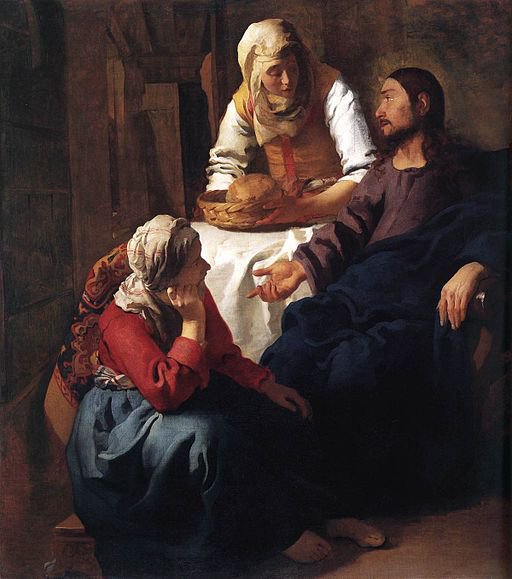
Martha, on the other hand, was busy. She was anxious. She didn’t make the time for wisdom or for receiving the teaching of the Lord. Jesus identifies the reason; she was anxious and worried about things that she didn’t need to worry about. This invariably leads to sin. Martha becomes prideful thinking that her sister is wronging her. She becomes envious of her sister, declaring to Jesus Mary’s alleged faults and commanding Jesus to make her help. When we let our anxiety about the world control us, we are brought down into sin.
So, are we more like Mary or Martha? Do we take the time to read the Scriptures and study our Catholic faith in order to receive the wisdom of the Lord? Or are we too busy? Do we make time to pray every day so that we are close to Jesus? Or are we too busy? Are we resolute on coming to Mass every Sunday and Holy Day of Obligation so that our hearts can be entirely filled with the Eucharistic presence of Jesus? Or sometimes, are we just too busy and anxious about the world? If we want to be like Mary, we need to make time for study, for prayer, and the sacraments. These are the means by which we draw close to Jesus and listen to Him speak to us.
It’s easy to neglect our life of prayer and worship, but we need to stay focused on the better part Mary chose. Jesus says “There is need of only one thing,” that is, to center one’s life on the words of Jesus. We need to treasure our time with Jesus as the pearl of great price. He needs to be the beginning and end of all that we do. If we are faithful to this, no matter the trials and suffering it brings, then, one day Jesus well tell us that we have chosen the better part and that it will not be taken from us. Our love for Jesus will console us for eternity.
Wednesday, July 17, 2013
The God of Jacob Has Sent Me To You

ready for the celebration. My mother appointed me to drive into town in order to pick up the cake and bring it to the banquet hall for the reception. Along the way, I made a stop at Wal-Mart and on my way out of the store, I notice people at a table handing out materials about how to correctly interpret the Bible. I got a little excited! Too many people aren’t willing to talk about religion or their faith beliefs, so here was my opportunity to have an interesting conversation! I strode over before asking them which denomination they represented. They identified themselves as Jehovah Witnesses. I told them that I was studying to be a Roman Catholic priest. The conversation got interesting real fast.
There are two things I admire about the Jehovah Witnesses. First, they’re willing to proclaim Jesus Christ as their Lord and Savior from the roof tops. They aren’t afraid to use words when necessary. I admire that zeal for evangelization. Second, they strongly affirm that God has personally revealed Himself to humanity even giving Moses His personal name by which he wants to be known. In fact, that’s why they’re called Jehovah’s Witnesses. Jehovah is their pronunciation of the Hebrew Yahweh. They strongly affirm that God is knowable and personable.
But if the Jehovah Witnesses already believe in God, why should I go and talk with them and share with them my Catholic Faith? Jehovah Witnesses and Catholics have very fundamental differences. Catholics say that God is a Trinity of Father, Son, and Holy Spirit: three persons in one God. The Jehovah Witnesses deny that; they don’t think that Jesus Christ was God. So why debate with the Jehovah Witnesses about the divinity of Jesus? Because the Jehovah Witnesses believe that God is knowable and personable.
While the Incarnation makes God all the more transcendent and mysterious; it also makes Him all the more knowable. That the Son of the Father could assume a human nature is incredible and incomprehensible. At the same time, the Invisible Word of God, by the incarnation, is translated into a human language. The personality of the Son takes a human expression that we can understand. The truths of the Catholic faith complete and perfect the truths found in other religions and Christian denominations. The Catholic Church contains the fullness of the truth for which every human heart is longing. I tried to evangelize the Jehovah Witnesses because God has given me something to share with them.
This is exactly what’s happening when God reveals His name to Moses. God reveals His name to Moses and then sends him to the Israelites so that they might worship the one, true God. God gives Moses a truth to share so that Israel might have a more personal relationship with their heavenly Father. As Christians, we are called to share, not simply the name of God, but the Gospel of Jesus Christ “who, though he was in the form of God, did not regard equality with God something to be grasped at. Rather, he emptied Himself, taking the form of the slave… obedient to death, even death on the Cross” (Phil 2:6-8). You see, God so loved the world that He gave His own life to redeem us. We need to go out into the world and preach that love.
Thursday, July 11, 2013
For the Sake of Saving Lives
“It was really for the sake of saving lives that God sent me here ahead of you” Gen 45:6. What Joseph’s brothers had meant as an evil God allowed as something good. This is an important lesson. Evil has no power to thwart God’s plans; rather God writes straight with crooked lines. You want to sell you brother into slavery? That’s not a problem. God already has a plan with how to deal with it. Whether the evil you’re facing is sin or death, that’s not going to stop God.
Look at how God took care of Joseph. He was sold into slavery abused by his master and thrown into prison, but God took care of him so that Joseph would be in the position to save people’s lives. Joseph saved many lives, many Egyptians, and even those of his own family. While Joseph didn’t know what God’s plan for him was. He trusted that there was a plan.
In the Gospel reading for today, we see the same message. Jesus tells His disciples (that means you and me) not to bring any money or a sack or any spare clothes or sandals or even a walking stick. Rather, they have to entrust everything to God’s providence. When God’s people are out doing God’s work, they don’t need to worry about how they’ll be taken care of. They know that everything—everything—works for the good of those who love the Father. So I put this question before you: how are you going to trust God today? Are you going to trust Him with your finances? Are you going to trust Him with your friends? Find an area in your life, today, and entrust it to God.
And do this every day. One thing I do every morning (and I’ll end my reflection with this) is to pray a simple prayer by Charles de Foucauld. It goes like this “Father, I abandon myself into your hands, do with me what you will. Whatever you do, I thank you. I am ready for all; I accept all. Let only your will be done in me and in all your creatures. I ask for no more than this, O Lord. Into your hands Lord I commend my Spirit. I offer it to you with all the love of my heart, for I love you, Lord and so dearly wish to give of myself, to surrender myself into your hands, with boundless confidence for you are my Father.”
Look at how God took care of Joseph. He was sold into slavery abused by his master and thrown into prison, but God took care of him so that Joseph would be in the position to save people’s lives. Joseph saved many lives, many Egyptians, and even those of his own family. While Joseph didn’t know what God’s plan for him was. He trusted that there was a plan.
In the Gospel reading for today, we see the same message. Jesus tells His disciples (that means you and me) not to bring any money or a sack or any spare clothes or sandals or even a walking stick. Rather, they have to entrust everything to God’s providence. When God’s people are out doing God’s work, they don’t need to worry about how they’ll be taken care of. They know that everything—everything—works for the good of those who love the Father. So I put this question before you: how are you going to trust God today? Are you going to trust Him with your finances? Are you going to trust Him with your friends? Find an area in your life, today, and entrust it to God.
And do this every day. One thing I do every morning (and I’ll end my reflection with this) is to pray a simple prayer by Charles de Foucauld. It goes like this “Father, I abandon myself into your hands, do with me what you will. Whatever you do, I thank you. I am ready for all; I accept all. Let only your will be done in me and in all your creatures. I ask for no more than this, O Lord. Into your hands Lord I commend my Spirit. I offer it to you with all the love of my heart, for I love you, Lord and so dearly wish to give of myself, to surrender myself into your hands, with boundless confidence for you are my Father.”
Sunday, June 30, 2013
For Freedom Christ Set us Free
 Jesus radically surrenders to the plan of the Father. “When the days for Jesus’ being taken up were fulfilled,
he resolutely determined to journey to Jerusalem.” When the time ordained by the Father arrived, Jesus turned his face towards Jerusalem where he would offer his whole life as a sacrifice for sins. This whole-hearted surrender to the Father is model for our personal discipleship.
We can see this dynamic of surrender in Elijah and Elisha. Elijah was called by God to choose his successor: Elisha. Elijah heeded the Lord’s command and threw his cloak around Elisha as a sign of taking him into his own family. Elijah invited Elisha to a familial relationship; he didn't force him, but Elisha hesitated for a moment saying, “Please, let me kiss my father and mother goodbye, and I will follow you.”
Elijah’s invitation to Elisha is closely paralleled by Jesus. He too extended the invitation of discipleship. He said, “Come follow me!” However, Jesus was met by excuses: “let me go first and bury my father” and “Let me say farewell to my family at home.” In and of themselves, these are good and things, but not when they prevent you from following the will of God. Jesus saw into their hearts and knew them to still be divided in their loyalties to him, so he rebukes their excuses.
As St. Paul wrote, “For you were called for freedom, brothers and sisters. But do not use this freedom as an opportunity for the flesh; rather, serve on another through love.” Jesus invites us to freely choose him. This freedom isn’t for the sake of selfishness, or as St. Paul calls it, slavery to the flesh. Freedom is for love, especially love of God. It is when we love and give ourselves in complete service to the Father that we find ourselves most free.
In contrast to Jesus’ would-be followers, Elisha responded to Elijah’s invitation in freedom and love. Rather than go back and put his hand to the plow, Elisha took the plow and he burned it. He slaughtered his cattle and had them eaten, completely cutting himself off from his previous agrarian life. This is an allegory. Elisha didn’t give an opportunity to the flesh to corrupt his freedom. He put sin to death by the flames of love. He boiled the flesh and turns from his old life into a new life following Elijah as his attendant. This is the sort of total, radical, free, and immediate commitment that Jesus is looking for in his own disciples.
The power to freely surrender to the will of the Father comes from the Holy Spirit. Paul writes, “I say then: live by the Spirit and you will certainly not gratify the desire of the flesh.” It is the Spirit who reminds us of all that Jesus has taught us. It is the Spirit who bestows on us grace. It is the Spirit who makes us children of the Father. Finally, it is the Spirit who brings us freedom for “if you are guided by the Spirit, you are not under the law.” Those who are guided by the Spirit have no need of the law because they are already filled with love. No one needs to tell them not to steal or murder. My brothers and sisters, this is freedom: loving totally and radically without hesitation. This is the very love with which Jesus loved us when he resolutely determined to journey to Jerusalem.
Subscribe to:
Posts (Atom)